
Earn Money with your website simply by referring FileSonic.com

Friday, January 7, 2011

New Zealand let it slip after lunch

Tea New Zealand 160 for 5 (Young 2*, Williamson 12*, Rehman 2-32) v Pakistan
Pakistan compensated for the lack of assistance from the Seddon Park pitch with a more determined effort after lunch that undermined a strong foundation laid for the New Zealand innings by Brendon McCullum. His dismissal shortly after the break, the subsequent stagnation against Abdur Rehman's left-arm spin and the run-out of Jesse Ryder, just when he was trying to inject some fluency to the innings, tilted the scales after it had seemed Pakistan had erred by opting to field on a dryish surface.

New Zealand had themselves to blame for the turn in the tide. Their batsmen didn't take advantage of opportunities given, through umpiring errors or lapses in the field, and lost track during a shift in momentum brought about by Martin Guptill's self-imposed grind. He played out five consecutive maidens against Rehman, who kept a tight line around middle and off and despite the lack of turn was met respectfully with a straight bat that seemed devoid of intention to force the pace.

It was McCullum's wicket, though, that was the trigger. Since giving up wicketkeeping duties in Tests, McCullum has enjoyed his role at the top of the order and looked set for a big score when he took off this morning. He went after Umar Gul in the first over, driving him over the in-field and despite there being a deep point and two fielders square on the leg side, showed no inhibitions playing the cut and the pull with success. He was even more ruthless against deliveries that were pitched up, driving Younis Khan and Wahab Riaz to the extra-cover boundary before dispatching Gul over the ropes soon after lunch. He followed up with a mow over midwicket for another six but fell to a trap, slashing Gul the same over to a perfectly-placed deep point.

Rehman, brought on after lunch, attacked with a slip and two close-in catchers on either side of the pitch. He bowled quicker through the air, from a flat trajectory and only managed to extract some spin when he flighted the ball. None of this, however, was by any means threatening but the nagging line sent Guptill into a shell that he only managed to free himself from with his wicket.

Balls were either pushed back to Rehman, or knocked around past the close-in fielders but the singles were absent. Guptill had looked quite assured against pace, leaving deliveries in the channel outside off in the morning session where there was a bit of nip, and kicking things off with a couple of lovely straight drives. But his misery against Rehman - he had scored 4 off 44 balls against him - ended when the bowler had given him the best possible chance to score; the full toss, however, was gifted as a catch to cover.

In the interim, Taylor, who had a poor time in the Tests against India, feathered one to the keeper as he tried to cut Rehman while Ryder, keen to restore the advantage gained earlier in the day, batted enterprisingly. Deliveries strayed on the pads by the spinners were deftly shown the way to the fine-leg boundary and when the opportunity came, Rehman was slog-swept for a six over midwicket. But a moment of ill luck robbed him of his wicket as he was run-out backing up too far as Wahab Riaz deflected a straight drive onto the stumps at the non-striker's end. Despite his half-century, it was a forgettable day for the man who played that drive, Guptill.

England complete crushing Ashes victory

England 644 (Cook 189, Prior 118, Bell 115) beat Australia 280 (Johnson 53, Anderson 4-66) and 281 (Smith 54*, Anderson 3-61, Tremlett 3-79) by an innings and 83 runs


England ended 24 years of hurt in crushing style at the SCG as they secured an innings-and-83-run victory to take the Ashes series 3-1. The crowning moment came shortly before noon when Chris Tremlett found Michael Beer's inside edge to bowl him leg stump. It was the first time in their history that Australia have suffered three innings defeats in a series and left nobody in any doubt where the balance of power now lies.

The England players immediately embraced at the striker's end and savoured their moment in a tight team huddle. This has been a victory fashioned by exemplary planning and hard work where no stone has been left unturned. The defeat in Perth, by 267 runs, which levelled the series for Australia, only inspired the visitors to hit new heights and they proceeded to crush the hosts in Melbourne and Sydney.

England were frustrated for a while as showers scudded across the ground to cause a 45-minute suspension and then by an 86-run stand between Steve Smith and Peter Siddle. However, Graeme Swann broke through shortly before the new ball and a short time later Tremlett removed the last obstacle.

Smith and Siddle at least showed some fight as they came out and played their shots. Siddle's batting improvement since his return from injury is one of few bonuses to emerge from a terrible series for the hosts, and it highlights their problems that his run-scoring record is not far off that of Ricky Ponting and Michael Clarke.

The England bowlers couldn't quite recapture the intensity of the fourth evening when they claimed the extra half hour to try and wrap up victory. Tremlett appeared a little down on pace after his roaring burst the previous day, but England knew all they had to do was remain patient and their moment would arrive.

Swann had bowled well in the innings without reward so when he had Siddle taken at deep midwicket it was deserved success for giving Andrew Strauss control at vital stages. That was Swann's final bowl, though, as the new ball was taken straight away and Anderson, who will head home for ten days' rest, found Ben Hilfenhaus' edge to give the impressive Matt Prior another catch.

By now the Barmy Army were in full voice. Smith had time to bash his way to a second Test fifty, but he knew the end was close as he swung from the hip. A single exposed Beer to three balls of Tremlett's over and he only needed one delivery. England will party the day and night away in Sydney, yet knowing the focus of Strauss and Andy Flower they will soon be back preparing for the next challenge. Next stop: the best team in the world.

Gritty Gambhir leads India to 1-1 draw

South Africa 362 (Kallis 161, Amla 59, Sreesanth 5-114) and 341 (Kallis 109*, Boucher 55, Harbhajan 7-120) drew with India 364 (Tendulkar 146, Gambhir 93, Steyn 5-75) and 166 for 3 (Gambhir 64)


An insipid performance from India's bowlers on the fourth day had broken their aspirations of a maiden Test series victory in South Africa but, on the fifth, the batsmen ensured they achieved at least a draw for the first time in the country. In an anticlimactic end to an enthralling contest, Gautam Gambhir was at the forefront of the Indian resistance, Rahul Dravid blocked lots of balls, and South Africa's bowlers toiled 82 overs for three wickets, when they needed ten.

South Africa fell behind early in their pursuit of victory and eventually took only one wicket in each session. The key to their chances lay in how many they dismissed with the new ball, and India won a decisive battle by surviving the first 11 overs without damage. Dale Steyn and Morne Morkel weren't as hostile as they were in the first innings but still bowled aggressively in the morning. Once that threat passed, India's passage was easier. They survived one more flutter of anxiety, soon after Dravid fell late in the second session, when AB de Villiers failed to catch an extremely tough chance off Gambhir. The game was called off with umpteen fielders waiting for catches that never came, and South Africa were still winless in a series at home since Bangladesh's visit in November 2008.

India did not try to win this deciding Test on its final morning - the target of 340 was always out of reach - but because they focused on survival and scored at about two runs an over, Graeme Smith was able to place as many close catchers as he pleased. Steyn got the ball to seam and swing away, though he wasn't as terrific as he was on the third day. Morkel posed the greater threat, targeting the bodies of both openers with balls that jagged into them from short of a length. One screamer from round the wicket rose so steeply that even Gambhir's best efforts to avoid it failed. The ball thudded painfully into his left arm, just below the elbow. It was the same injured arm that kept him off the field during South Africa's second innings and has ruled him out of the ODI series. Gambhir got it treated, and took guard again.

It made sense for Gambhir to try and face Steyn, while Sehwag countered Morkel. Steyn's swing into the left-hander's pads made it easier for Gambhir to face him. Sehwag, however, struggled against Morkel, getting hustled by deliveries that homed in at his body and beaten by others that straightened.

South Africa's first chance came when Lonwabo Tsotsobe replaced Steyn in the 11th over and Sehwag slashed him. The ball flew towards JP Duminy, standing deeper at point, and burst through his hands as he mistimed his jump. The let-off cost South Africa only a few deliveries, though, for in the next over Sehwag hung his bat out and edged Morkel to Boucher. Umpire Ian Gould asked the third umpire to check if Morkel had overstepped. He hadn't, by the smallest of margins. Sehwag's dismal tour was over; 144 runs in six innings was all he got.

The pressure eased when Tsotsobe and Harris were operating. Gambhir and Dravid blocked, left, and blocked some more. Dravid was careful to play Harris with bat in front of pad, ensuring nothing would pop up to the close catchers. The ball was turning, and it was seaming, but it was doing both slowly. India passed 50 when Gambhir jumped down the pitch and drove Harris to the cover boundary, but runs were of little consequence.

On either side of the lunch break, Smith brought himself on to bowl offbreaks and a couple spun sharply. He changed his bowlers frequently but for the majority of the second session Gambhir and Dravid were untroubled and they collected easy runs by exploiting unprotected boundaries. Gambhir slashed and cut Steyn through point twice and reached a valuable half-century. Dravid simply used up deliveries and scored when he could, scoring three soft fours in a Smith over. Before those boundaries he had played 89 balls for 18 runs.

In the 44th over, just when the Test seemed to be entering a phase of defensive torpor, Harris began to make things happen off the pitch. He ripped and bounced one sharply across Dravid and later in the over struck him low on the back foot in front of middle stump. The ball hit pad before bat but Gould said not out. Dravid played only 15 more balls, though, before edging Tsotsobe off the front foot to the cordon.

The opportunity to dismiss Gambhir, on 62 off 146 balls, came soon after, when a leading edge flew quickly to de Villiers at silly point. He grabbed repeatedly at the sharp chance but spilled the ball and Harris held his head. Gambhir played 37 more balls. Tendulkar was solid for 91 deliveries and he remained unbeaten, walking off Newlands with the series shared. VVS Laxman too couldn't be budged, after Gambhir had gloved Steyn's short ball down the leg side for 64. It was Boucher's 499th catch.

Steyn and Morkel's spells after tea were South Africa's last chance. They returned for one final attempt, an over each with the second new ball. Both were fruitless. India scored only 166 runs today and saved the series.

Monday, January 3, 2011

Australia top order battles hard


Tea Australia 2 for 111 (Khawaja 26*, Clarke 4*) v England
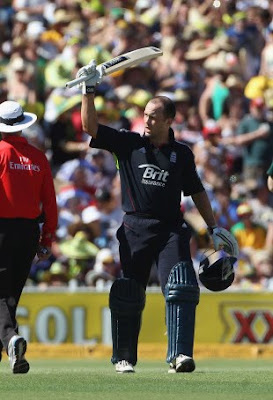
A determined effort from Australia's top order laid a solid foundation on the opening day at the SCG as the hosts reached 2 for 111 when rain brought an early tea in their quest to salvage Ashes pride. Phil Hughes and Shane Watson battled hard against the new ball on an overcast morning before both fell to disappointing shots, but Usman Khawaja settled impressively into Test cricket.

The openers were four balls away from surviving the first session when Hughes edged Chris Tremlett, the pick of England's bowlers, to third slip and Watson, who didn't collect a boundary during the first two hours, fell to Tim Bresnan after yet another unfulfilled innings. Khawaja, though, sped to 15 from his first eight balls and was joined by new captain Michael Clarke who received a mixture of boos and cheers when he walked in.

Clarke earlier won his first toss as Australia's 43rd Test captain and although batting first is normally the preferred option on a pitch that takes turn, a muggy morning meant England's quicks were not without encouragement. However, whereas they regularly found the edge in Melbourne here the ball beat the bat frequently, especially in the first hour, without getting reward.

Tremlett caused the most problems during a probing first spell where he trouble Watson and Hughes with extra bounce. James Anderson also found swing to have a couple of stifled lbw shouts although he was troubled by his take-off area, almost turning his ankle with his second ball, and also gained a warning for his follow-through from Billy Bowden. His first spell ended with figures of 5-0-5-0 and after 12 overs Australia had 17 runs, but the value of not losing early wickets was far greater than what the scoreboard showed.

The determination started to pay off as Hughes tucked into Bresnan's second over with a drive followed by a cut to collect consecutive boundaries and he then cut Graeme Swann's second ball for four to raise Australia's fifty.

Watson gave a good lesson in leaving on length as Tremlett's deliveries kept sailing over the stumps, but Hughes wasn't quite equal to the challenge when he pushed outside off and offered a simple chance to third slip having begun to show England he could handle the top level. It meant Khawaja had 40 minutes to ponder his first ball in Tests, but he calmly clipped his opening offering from Tremlett through the leg side for two then cracked away a bristling pull next ball.

Watson finally located the boundary from his 89th ball with a clip through midwicket, but it was Khawaja who was now attracting the attention. He was given another gift on leg stump which was flicked away and had the skill to play with soft hands so when he twice edged it fell short of second slip.

Either side of a needless stoppage for bad light, he appeared to have plenty of time to play his shots, guiding Tremlett down to third man, and was confident to come into the front foot in defence. Watson was also starting to find his rhythm with a front foot pull through midwicket and a sweet clip off the pads that whistled to the boundary.

However, with another half-century in sight Watson played forward to Bresnan and the ball shaped away a touch to find the edge and was well taken at first slip. Watson slammed his bat in frustration before dragging himself off the pitch. After a mixed reception, Clarke leant on a cover drive first ball to open his account but the rain was closing in and three overs later the players went off with the contest brewing up nicely.

Amla and Kallis steer through testing day


South Africa 232 for 4 (Amla 59, Kallis 81*) v India

South Africa's batsmen were tested severely by seam and swing on a stop-start day dominated by drizzle, murky light and a Table Mountain shrouded in cloud. By the time Newlands was bathed in glorious evening sunshine, though, the home team had lost only four wickets and had denied India the rewards that appeared imminent during the morning and afternoon. Hashim Amla and Jacques Kallis, the most resolute of South Africans, manned the frontline and three consecutive half-century partnerships ensured the hosts edged ahead in the fight for the series.

The weather, the pitch and the Indian seamers examined South Africa's batting skills after MS Dhoni won his first toss in the New Year, having lost all but one of his previous 14. There were two rain interruptions and the natural light had to be supplemented by artificial ones, which required the batsmen's concentration to be at its peak. The pitch offered the bowlers assistance throughout, forcing the batsmen to be alert to the one that would suddenly jag back in, or seam sharply away. They edged plenty, but most flew into gaps in the field.

South Africa's innings had come to a standstill after they lost their openers - Graeme Smith shortly before the first rain interruption and Alviro Petersen soon after. It sparked to life during the period between the second rain break and tea, with Amla playing the protagonist.

Amla had batted with discipline, leaving majority of the deliveries outside off stump, especially when Zaheer Khan seamed them across him from over the wicket. Zaheer also went around the stumps and caused problems, beating Amla with a blockhole delivery outside off, inducing an inside edge past the stumps and a leading edge that lobbed dangerously towards cover - all in one over.

The pitch at Newlands wasn't as quick or bouncy as the one at Kingsmead, where batsmen could leave the ball on length. India's bowlers had not attempted a single bouncer when bad light and rain stopped play for a second time, with South Africa 61 for 2 after the 21st over. It was not that sort of pitch.

It was a pitch on which the bowlers needed to bowl fuller, and the Indians did. It was a pitch on which the batsmen needed to be made to drive, and the South Africans did. Kallis had driven Sreesanth with power through cover just before the rain, but Amla took charge after the second resumption.

He drove the first ball after the break from Zaheer through point, the next wide of mid-on, where Sachin Tendulkar dived over the ball, and another between midwicket and mid-on - all for boundaries. Sreesanth also urged Amla to drive by delivering swinging half-volleys outside off, two of which disappeared across the moist turf towards the cover boundary. In 4.1 overs after the second drizzle, South Africa had scored 30.

Sreesanth then tried a different line of attack, placing men at long leg and deep square and bouncing Amla, who hooked the first for six to reach 50 off 69 balls. Amla continued to attack, but not all his shots came off. He edged Sreesanth twice, first over gully and then wide of second slip. Zaheer also produced two crackers that pitched straight and seamed across the outside edge of Amla's forward pushes. On 59, Amla pulled Sreesanth again, but this time he spliced the short ball to Cheteshwar Pujara on the deep-square boundary. It was the only wicket that India took during the second session and it ended a partnership of 72.

Kallis had been quiet during Amla's burst but he assumed leadership of the resistance with AB de Villiers for company. Kallis had shouldered arms to his second delivery, from Ishant, and had been hit high on the thigh. He was later struck on the body while pulling, and he was batting with a wrist bruised during his dismissal at Kingsmead.

He faced a difficult over from Ishant right after tea, getting beaten by deliveries that straightened from a good length just outside off stump. He responded to that by flicking the bowler confidently through midwicket, growing his partnership with de Villiers, who had to tailor his free-scoring game to the conditions.

Harbhajan Singh was bowling economically, and the fast bowlers were always threatening to strike. Sreesanth did, inducing the edge from de Villiers with a perfect outswinger, snipping the stand at 58. Sreesanth also had an lbw shout against Kallis, on 54, but his appeal wasn't convincing even though replays indicated the ball would have hit the top of leg stump.

A noticeable aspect was the lack of aggression from India's bowlers today, compared to their performance in Durban, and they were slower in pace too. And once the sun came out, and the seamers tired, survival became relatively easier. Kallis was assured towards the end of the day, Prince was edgy at the start of his innings and they also added 68 runs to make Smith the happier captain at stumps.

Earn money from online

 
Design by Free WordPress Themes | Bloggerized by Lasantha - Premium Blogger Themes | Grants For Single Moms